
Context
Cross-cloud migration is rarely a clean re-platform. Real workloads are tangled with dependent components — databases, message queues, secret stores, identity providers, internal services — each with its own runtime expectations and operational quirks. For one of our enterprise clients, the goal was clear: move a portfolio of microservices and their dependent components from AWS to Alibaba Cloud (Alicloud), while preserving service quality for end users throughout the transition. We adopted a lift-and-shift approach for some components and re-platformed others to leverage Alicloud-native services for three critical applications.
Why Migrate?
The primary drivers for migrating from AWS to Alibaba Cloud were:
- Lower infrastructure costs — better unit economics for the workload mix on Alibaba Cloud.
- Enhanced performance and latency for the market — improved proximity to target user geographies.
- Consolidation of services into a unified cloud ecosystem — strategic consolidation onto a single cloud vendor.
- Cross-cloud resilience strategy — building muscle for multi-cloud operations.
Migration Strategy: Lift and Shift with Selective Re-platforming
We adopted a hybrid migration strategy, primarily using a lift-and-shift approach to move existing workloads without redesigning applications, complemented by selective re-platforming to leverage Alicloud-native services. This let us quickly transition workloads while optimising for Alicloud's ecosystem.
- Lift-and-Shift for components where speed and minimal application change mattered more than long-term optimisation.
- Selective Re-platforming for components where the target cloud's managed equivalents made the workload simpler, cheaper, or both — particularly databases and container orchestration.
This avoids the two common traps in cloud migration: trying to rewrite everything (slow, risky), or doing a pure lift (cheap upfront, expensive over time).
Key Migration Tools
SMC (Server Migration Center)
Lift-and-shift for VM-based components from AWS EC2 to ECS, with consistent imaging and minimal downtime.
DTS (Data Transmission Service)
Database migration and ongoing replication — keeping data consistent during cutover windows.
ACK (Container Service)
Alibaba's managed Kubernetes — landing zone for microservices that benefited from re-platforming.
Server Migration Center (SMC)
Alibaba Cloud Server Migration Center (SMC) is a versatile tool designed to simplify the migration of servers — including virtual machines, physical servers, and cloud instances — to Alibaba Cloud. SMC supports cross-cloud migrations by creating custom images of source servers and deploying them as Elastic Compute Service (ECS) instances. Its agent-based approach ensures minimal downtime and preserves server configurations.
Data Transmission Service (DTS)
Alibaba Cloud Data Transmission Service (DTS) is a robust data migration and synchronization tool that supports homogeneous and heterogeneous database migrations. DTS enables full data migration followed by incremental synchronization, ensuring data consistency during the transition. It is particularly effective for cross-cloud database migrations with minimal application downtime.
Compute Migration (EC2 to ECS)
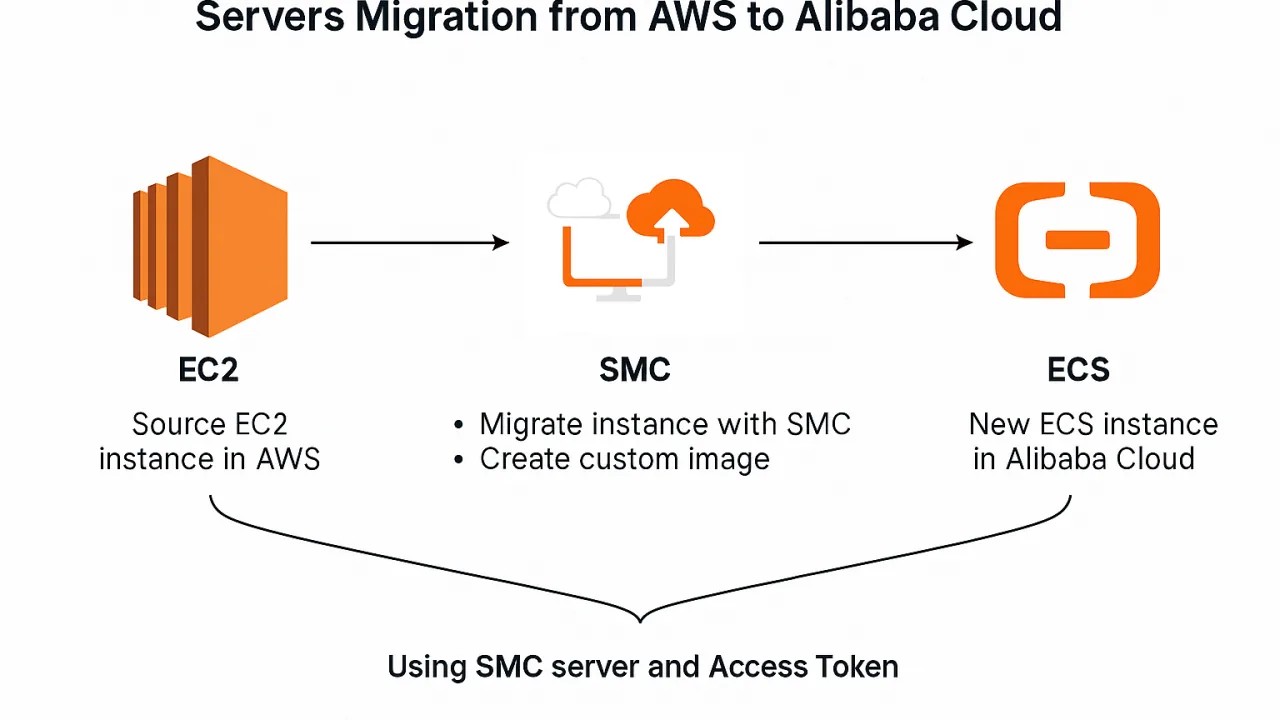
In AWS, our applications were deployed on EC2 instances using Nginx and Apache web servers, with some microservices running on an Elastic Kubernetes Service (EKS) cluster. Docker images were stored in Amazon Elastic Container Registry (ECR). To migrate these compute resources, we used Alibaba Cloud Server Migration Center (SMC).
Steps
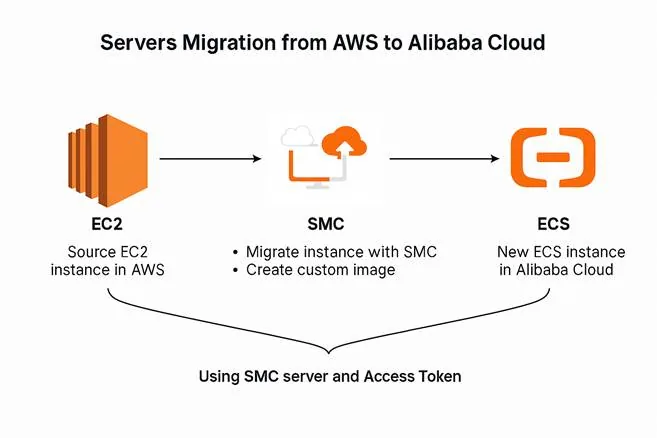
- Source Machine Discovery — installed the SMC client on EC2 instances to collect server metadata and configurations.
- Image Creation — created custom images from the source EC2 instances, capturing the operating system, application configurations, and dependencies.
- Instance Launch — launched new ECS instances in Alibaba Cloud using the custom images, ensuring compatibility with Alicloud's infrastructure.
- Containerized Workloads — for microservices previously running on EKS, we deployed Docker images as containers on ECS instances and Alibaba Cloud Container Service for Kubernetes (ACK). Images were stored in Alicloud's Container Registry.
Database Migration (RDS to ApsaraDB)
Our applications relied on Amazon RDS instances for database services. We migrated these to ApsaraDB for RDS using Alibaba Cloud Data Transmission Service (DTS).
Steps
- Preparation — created ApsaraDB for RDS instances in Alicloud, matching the source RDS configurations (e.g., MySQL or PostgreSQL).
- Security — whitelisted Alicloud DTS IP addresses in the AWS RDS Security Group to allow secure data transfer.
- Data Sync — configured DTS for full data migration followed by incremental synchronization to capture ongoing changes.
- Final Cutover — validated data consistency, updated application connection strings, and switched to the ApsaraDB instances.
Additional Service Migrations
Beyond compute and database migrations, we re-platformed several AWS services to their Alicloud equivalents to optimise our architecture.
ElastiCache to ApsaraDB for Redis
AWS ElastiCache instances were replaced with ApsaraDB for Redis. We migrated cached data using Redis-compatible migration tools and updated application configurations to point to the new Redis instances.
S3 to OSS
Object storage was migrated from AWS S3 to Alibaba Cloud Object Storage Service (OSS). We used Alicloud's migration tools to transfer files and data, ensuring bucket policies and access controls were replicated.
ELK Stack Migration
The Elasticsearch, Logstash, and Kibana (ELK) stack, previously hosted on AWS, was redeployed as containerised workloads on Alibaba ECS instances. We used Docker images stored in Alicloud's Container Registry to streamline deployment.
Application Deployment in Alicloud
In AWS, our applications were hosted using Elastic Beanstalk, with DNS managed by Route 53 and certificates handled by Cloudflare and AWS Certificate Manager. In Alicloud, we adopted a different approach:
- Microservices Deployment — each application's microservices were deployed as Docker containers on ECS instances or ACK clusters, leveraging Alicloud's Container Registry for image storage.
- Web Servers — continued using Nginx and Apache on ECS instances for serving application frontends.
- DNS and Certificates — configured Alicloud DNS (Alibaba Cloud DNS) for domain management and used Alicloud SSL Certificates for secure connections.
Execution Approach
- Inventory & dependency mapping — every microservice and its dependencies (DBs, queues, secrets, downstream services) catalogued before any movement.
- Wave planning — workloads grouped into migration waves by coupling, criticality, and complexity.
- Foundational landing zone on Alibaba — networking, identity, security, observability baseline established first.
- Pilot wave — lowest-risk services migrated first to validate tooling, runbooks, and rollback paths.
- Data sync & cutover — DTS used to keep databases in lock-step until cutover; cutovers performed inside well-defined change windows.
- Re-platform where it pays — services that benefited from Alibaba's managed equivalents (ACK, RDS, etc.) were re-platformed in the same wave.
- Decommission AWS resources — only after sustained validation on Alibaba.
Migration Approach Summary
- Lift and Shift — migrated EC2 instances to ECS instances with minimal changes to application code.
- Re-platforming — RDS to ApsaraDB for RDS for database services; AWS ElastiCache to ApsaraDB for Redis for caching; AWS S3 to Alibaba OSS for object storage; ELK stack redeployed as containers on ECS.
- Containerisation — transitioned EKS-based microservices to ACK clusters and ECS-based containers.
Lessons Learned
- Dependency mapping is the actual project. The migration itself is mechanical once you truly understand the dependency graph.
- Treat the landing zone as a product — networking, IAM, observability foundations done well on the target cloud save months of pain later.
- DTS-based continuous replication dramatically shortens cutover windows and reduces business risk.
- Don't over-modernise mid-migration — re-platform only where the value is clear; defer aspirational rewrites.
- Reversibility matters — runbooks for rollback are as important as runbooks for migration.
Final Thoughts & Key Takeaways
By leveraging Alicloud-native services like SMC, DTS, and Container Registry, we efficiently migrated three critical applications from AWS to Alibaba Cloud. The service parity between AWS and Alicloud, combined with robust migration tools, minimised disruptions and preserved application functionality. The hybrid approach of lift-and-shift and re-platforming let us balance speed with optimisation for Alicloud's ecosystem.
- SMC streamlined the replication of compute resources across clouds.
- DTS ensured reliable, low-downtime database migrations.
- Alicloud's Container Registry and ACK cluster simplified containerised workload deployment.
- Security configurations (Security Groups, whitelisting) were critical for secure data transfer.
- Service mappings (S3 to OSS, ElastiCache to ApsaraDB for Redis) were straightforward, enabling seamless re-platforming.
This migration has positioned the client to achieve cost savings, improved application performance, and a unified cloud ecosystem tailored to their needs.